

There is a quiet revolution happening in the way women relate to their own bodies. For decades, the menstrual cycle was treated as a private inconvenience — something to be managed, masked, or simply endured each month. But a growing number of women are flipping that script. Instead of seeing their cycle as a monthly nuisance, they are learning to read it like a dashboard: a stream of real, useful information about their hormones, their energy, their mood, and yes, their fertility.
At the centre of that shift is something called the Fertility Awareness Method, or FAM. It is not new — the science behind it has been studied and refined for the better part of a century — but in 2026 it is having a genuine moment. Part of that is cultural: more women are questioning hormonal birth control, wanting fewer side effects, and craving a deeper understanding of how their own bodies actually work. And part of it is technological: the smartphone in your pocket can now track, chart, and learn your patterns in a way that would have astonished the doctors who first mapped the fertile window in the 1930s.
A woman checking her phone in soft morning light
This article is a thorough, honest, and warm guide to all of it. We will cover what the Fertility Awareness Method really is, the elegant science of the fertile window, the body signs that FAM relies on, the main methods you may have heard of (symptothermal, calendar/rhythm, Billings), and — crucially — where modern period-tracker apps genuinely help and where they absolutely do not. We will be straight with you about a point that too many glossy app adverts gloss over: an app prediction is a wonderful tool for awareness and for trying to conceive, but it is not the same thing as confirmed ovulation, and a calendar-style prediction alone is not reliable contraception. Understanding that distinction is the single most important thing you can take away from this piece.
Let’s begin.
What Is the Fertility Awareness Method (FAM)?
The Fertility Awareness Method is an umbrella term for a group of practices that help a person identify the days in their menstrual cycle when pregnancy is possible (the fertile window) and the days when it is not. It works by observing and recording one or more biological signs that change predictably across the cycle, and then interpreting those signs to map fertility in real time.
The key phrase there is “in real time.” Unlike a simple app that guesses your fertile window based on the average of past cycles, true FAM relies on observed body signals — your basal body temperature, your cervical mucus, the position of your cervix, and sometimes hormone test strips. These are signs your body produces this cycle, right now, which is why properly taught FAM is far more responsive than a calendar guess.
People use FAM for two broad, almost opposite goals:
- To achieve pregnancy (TTC — “trying to conceive”). By identifying the fertile window precisely, couples can time intercourse for the days when conception is most likely. This is where awareness apps shine and where the stakes of a “false positive” are low — at worst, you try on a slightly-off day and try again next cycle.
- To avoid pregnancy. Here, the same body signs are used to identify which days to abstain from unprotected intercourse or to use a barrier method. This is a far more demanding application. Done with proper instruction, consistency, and a method that confirms ovulation, FAM can be reasonably effective. Done casually, with app guesses alone, it is not reliable, and we will be very clear about that throughout this article.
It is worth separating two terms that get muddled. “Fertility Awareness Method” (FAM) and “Natural Family Planning” (NFP) describe essentially the same body-literacy skills. The historical distinction is mostly about context: NFP is the term often used in faith-based settings where the methods are used without barrier backup, while FAM is the more secular term and usually allows for barrier methods (like condoms) on fertile days. The biology underneath is identical.
What FAM is not is guesswork or folklore. It is grounded in reproductive endocrinology — the study of the hormones that drive your cycle. When you learn FAM well, you are essentially learning to read the same hormonal story that a fertility clinic reads from blood tests, only you are reading it from the outside, through the signs your body so helpfully provides.
A Short History: From the Rhythm Method to the Smartphone
To appreciate where we are in 2026, it helps to know how we got here.
The earliest scientific attempt to map fertility came in the 1920s and early 1930s, when two physicians working independently — Kyusaku Ogino in Japan and Hermann Knaus in Austria — established that ovulation occurs at a relatively fixed interval before the next menstrual period, rather than at a fixed point after the last one. This insight gave rise to the calendar (or “rhythm”) method, which estimated fertile days purely from the length of past cycles. It was a genuine breakthrough for its time, but it had an obvious weakness: it assumed cycles were regular and predictable, which for many women they simply are not.
The next leap came mid-century with the recognition that the body broadcasts ovulation through observable signs. Researchers documented that basal body temperature rises slightly after ovulation, giving a way to confirm that ovulation had occurred. Then, in the 1950s and 1960s, Australian doctors John and Evelyn Billings developed the Billings Ovulation Method, which taught women to identify their fertile window by observing changes in cervical mucus — a sign that, unlike temperature, rises before ovulation and can therefore warn of approaching fertility.
By the 1980s, fertility educators combined the best of these approaches into the symptothermal method, which cross-checks two or more signs (typically temperature and mucus, often with cycle-length rules) for greater accuracy. Large European studies of the symptothermal method in the 2000s and 2010s produced the strongest effectiveness data the field has ever had — when the method is taught properly and used consistently.
And then came the phone. The first period-tracking apps were little more than digital calendars, but the category has matured enormously. Today’s best apps blend cycle-length data, logged symptoms, temperature, mucus observations, and — increasingly — artificial intelligence that learns your individual patterns rather than applying a one-size-fits-all 28-day template. Resources like vyvecare and dedicated tools like the Vyve Period Tracker App represent this modern, AI-assisted chapter of a story that began nearly a hundred years ago with a calendar and a pencil.
The arc of that history matters because it reveals a pattern: each generation of fertility awareness got more responsive to the individual body. The rhythm method guessed from the past. Temperature confirmed the present. Mucus warned of the future. AI apps now try to weave all of it together. But — and this is the thread running through this entire article — better tools do not erase the fundamental biology. They help you read it. They do not replace the need to understand it.
The Science of the Fertile Window
Here is a fact that surprises most people the first time they hear it: in a typical menstrual cycle, there are only about six days on which intercourse can lead to pregnancy. Six. Out of an entire cycle that might run 24 to 35 days or more.
That narrow window is the single most important concept in fertility awareness, and once you understand the biology behind it, everything else clicks into place.
Why Only About Six Days?
The fertile window is defined by two simple biological facts that work together:
- The egg has a short life. After ovulation — the moment an ovary releases a mature egg — that egg survives for only about 12 to 24 hours. If it is not fertilised in that brief span, it disintegrates and is reabsorbed or shed. So from the egg’s perspective, fertility lasts barely a day.
- Sperm can survive much longer. Healthy sperm, deposited in the presence of fertile-quality cervical mucus, can survive inside the female reproductive tract for up to about five days (sometimes a little less, occasionally a touch more). That fertile mucus is essential — it nourishes sperm, shields them from the otherwise hostile acidic environment of the vagina, and creates channels that guide them upward.
Put those two facts together and the maths produces the fertile window. Because sperm can wait around for up to five days, intercourse on any of the five days before ovulation can result in pregnancy if sperm are still alive when the egg appears. Add the day of ovulation itself (and the few hours after, while the egg is still viable), and you get a fertile window of roughly six days: the five days leading up to ovulation, plus ovulation day.
In practice, the days of highest fertility are the two or three days immediately before ovulation and the day of ovulation. The days at the start of that window are fertile but less so.
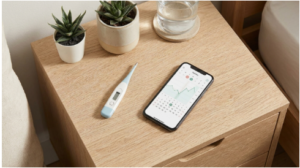
A basal thermometer and phone fertility chart
The Hormonal Story Behind the Window
To understand the signs FAM tracks, it helps to know the hormones that produce them. The cycle has two main phases divided by ovulation.
The follicular phase runs from the first day of your period until ovulation. During this phase, the pituitary gland releases follicle-stimulating hormone (FSH), which prompts a batch of follicles in the ovaries to mature. As one dominant follicle grows, it produces rising amounts of oestrogen. That rising oestrogen does several visible things: it thickens the uterine lining and, crucially for FAM, it changes cervical mucus from scant and tacky to clear, slippery, and stretchy — the famous “egg-white” mucus that signals approaching fertility.
When oestrogen peaks, it triggers a sudden surge of luteinising hormone (LH) from the pituitary. This LH surge is the trigger that causes the dominant follicle to rupture and release its egg — ovulation — usually about 24 to 36 hours after the surge begins. This is precisely the hormone that ovulation predictor kits (OPKs) detect in urine, which is why a positive LH test means ovulation is likely imminent.
The luteal phase runs from ovulation to the start of your next period. After releasing the egg, the empty follicle transforms into a structure called the corpus luteum, which pumps out progesterone. Progesterone is the hormone responsible for the small rise in basal body temperature that confirms ovulation has happened. It also dries up the fertile mucus and maintains the uterine lining. If pregnancy does not occur, the corpus luteum breaks down after about 12 to 14 days, progesterone falls, the lining is shed, and a new period — and a new cycle — begins.
One beautifully consistent fact emerges from this: the luteal phase tends to be relatively fixed in length (commonly 12 to 14 days) for a given person, while the follicular phase is the variable part. This is why ovulation does not reliably happen “on day 14” — that figure only holds for a textbook 28-day cycle. If your cycle is 32 days, you likely ovulate around day 18, not day 14. And if your cycle length jumps around, your ovulation day jumps with it. This single point is why calendar-only predictions can be so misleading and why observing real-time signs matters so much.
The Key Fertility Signs FAM Tracks
FAM turns invisible hormones into visible, recordable signs. Here are the four big ones.
1. Basal Body Temperature (BBT)
Your basal body temperature is your body’s temperature at complete rest, measured the moment you wake, before you get up, talk, drink, or even sit up. It is a small number — we are talking shifts of around 0.2 to 0.5°C (about 0.4 to 1.0°F) — which is why you need a sensitive basal thermometer rather than a standard fever thermometer.
Here is what BBT does: after ovulation, progesterone causes a sustained rise in your resting temperature. Before ovulation, temperatures sit in a lower range; after ovulation, they shift to a higher range and stay there until your next period (or stay elevated if you become pregnant).
The critical thing to understand about BBT is its timing: it confirms ovulation only after it has happened. The temperature rise is a rear-view mirror, not a windscreen. It tells you “ovulation occurred about a day or two ago,” which is hugely valuable for confirming the close of the fertile window — but it cannot warn you that ovulation is coming. That is why BBT alone is poor for predicting fertile days in advance and why it is almost always combined with mucus observations.
BBT is also sensitive to disruption. Poor sleep, alcohol the night before, illness, a fever, travelling across time zones, or even taking your temperature at a different time than usual can all throw off a reading. Wearable devices that measure overnight skin or wrist temperature continuously have improved the practicality of temperature tracking, but the underlying signal — and its limitations — remain the same.
2. Cervical Mucus
If BBT is the rear-view mirror, cervical mucus is the windscreen. Driven by rising oestrogen, mucus changes character across the follicular phase in a way that warns of approaching ovulation — which makes it the single most useful sign for identifying fertile days in advance.
The typical progression looks like this:
- After your period (low fertility): Often dry, or only a small amount of sticky, tacky, opaque mucus. Sperm struggle to survive in this environment.
- Approaching ovulation (rising fertility): Mucus becomes creamy, lotion-like, whiter, and more abundant as oestrogen climbs.
- Peak fertility: Mucus becomes clear, slippery, and stretchy — like raw egg white. It can stretch an inch or more between your fingers. This “egg-white cervical mucus” is the body’s green light: it is designed to help sperm survive and travel, and its presence signals the most fertile days. The last day of this slippery, lubricative mucus is called the peak day, and ovulation typically occurs around it.
- After ovulation (low fertility): Progesterone thickens and dries the mucus abruptly. Many people notice a sharp return to dryness or stickiness within a day of the peak.
Learning to observe mucus accurately takes practice and, ideally, instruction — it is more subjective than reading a thermometer. But because it is the one sign that predicts rather than confirms, it is the backbone of mucus-based methods like Billings and a core component of the symptothermal approach.
3. Cycle Length and Patterns
The length of your cycle — counted from the first day of one period to the day before the next begins — is the raw material that calendar-based prediction works from. Tracking it over several months reveals your personal range: are your cycles tightly clustered around 29 days, or do they swing from 25 to 38? That variability is itself important information.
Cycle-length data is where period-tracker apps are at their most natural. They are excellent at recording start dates, calculating averages, flagging unusually long or short cycles, and spotting trends over time. But cycle length is a backward-looking statistic: it tells you what your body did, which an app uses to estimate what it might do next. As we keep stressing, an estimate from past averages is not a real-time observation of this cycle. It is a starting hypothesis, not a confirmation.
4. LH and Ovulation Tests
Ovulation predictor kits (OPKs) detect the LH surge in urine. A positive result means the surge is underway and ovulation is likely within roughly 12 to 36 hours. For people trying to conceive, OPKs are a popular and useful way to catch the most fertile day or two, and they pair beautifully with app-based tracking: the app narrows down when to start testing, and the strips pinpoint the surge.
Like BBT and mucus, though, LH tests have caveats. They tell you a surge is happening, but a surge does not guarantee the egg was released (occasionally a follicle fails to rupture). Some conditions, such as polycystic ovary syndrome (PCOS), can produce misleading or multiple LH readings. And they predict ovulation, they do not confirm it after the fact the way a temperature rise does. The most complete picture comes from combining signs — which is exactly what the symptothermal method does.
The Main FAM Methods, Explained Simply
“FAM” is not one single technique. It is a family of methods that differ in which signs they track and how strictly they interpret them. Here are the three you are most likely to encounter.
The Symptothermal Method
The symptothermal method (STM) is widely regarded as the most robust form of fertility awareness, and it is the method behind the strongest effectiveness studies. The name says it all: sympto (symptoms — primarily cervical mucus, sometimes cervical position) plus thermal (basal body temperature). Many practitioners also fold in calendar-based rules as an extra cross-check.
The logic is one of double confirmation. Mucus opens the fertile window (warning that ovulation is approaching), and the sustained temperature rise closes it (confirming ovulation has passed). By requiring agreement between an advance sign and a confirming sign, STM hedges against the weakness of any single indicator. If your mucus says one thing but your temperature says another, the conservative rule wins, which keeps the method cautious where it counts.
This cross-checking is precisely why STM, taught well and followed consistently, has the best track record among FAM methods. It is also why it asks the most of the user: you need to observe and chart at least two signs daily, and you need to learn the interpretation rules properly.
The Calendar (Rhythm) Method
The calendar method — the historical “rhythm method” — predicts fertile days purely from the length of past cycles, with no real-time body observation at all. A classic version (the Knaus-Ogino calculation) takes your shortest and longest cycles over many months and applies formulas to estimate the earliest and latest possible fertile days.
The calendar method is the simplest to understand and the easiest to do — and also the least reliable, especially for anyone whose cycles are not very regular. Because it only ever looks backward, it cannot account for a cycle in which you ovulate earlier or later than usual due to stress, illness, travel, or simple natural variation. This is the method most similar to what a basic app does when it draws a “fertile window” band on your calendar from your averages.
It is essential to be clear here: most period-tracker app predictions are, at their core, sophisticated calendar-method estimates. That makes them genuinely useful for awareness and for timing TTC efforts, but it also means a plain calendar prediction is not a reliable standalone contraceptive. The modern “fertility awareness-based methods of contraception” that perform reasonably in studies are the ones that add real-time signs (mucus, temperature, or LH) on top of — or instead of — the calendar.
The Billings Ovulation Method
The Billings Ovulation Method (and related cervical-mucus-only approaches such as the Creighton Model) relies on observing cervical mucus alone to identify the fertile window. Users learn to recognise the progression from dry to creamy to slippery egg-white mucus and to pinpoint their peak day.
The advantage of a mucus-only method is that it predicts fertility in advance, requires no thermometer or test strips, and works even when cycles are irregular, because it reads the body’s current hormonal state rather than relying on past averages. The trade-off is that mucus observation is subjective and takes good instruction to do reliably; factors like infections, lubricants, semen, and some medications can muddy the signal. For these reasons many educators consider mucus a brilliant predictive sign but recommend cross-checking it with temperature (i.e. moving toward a symptothermal approach) when the goal is avoiding pregnancy.
How Period-Tracker Apps Fit In — The Honest Version
Now we come to the heart of the matter, and the part where it is most important to be straight with you.
Period-tracker apps are some of the most downloaded health apps in the world, and for good reason. They are genuinely transformative for body literacy. But there is a wide gulf between what they are great at and what they should never be relied on for, and the marketing around some apps blurs that line. Let’s separate it clearly.
What Apps Are Genuinely Great For
Awareness and education. This is the big one. An app turns your cycle from a vague monthly mystery into a clear, visual record. Seeing your patterns laid out — when your period tends to come, when your energy dips, when symptoms cluster — is empowering and, for many women, genuinely the first time they have ever understood their own rhythm. A well-designed best period tracker does this brilliantly, and that learning has value entirely independent of contraception or conception.
Learning your individual patterns. Modern apps that use AI do not just apply a generic 28-day template; they learn your averages, your variability, and your symptom tendencies over time. The more accurately you log, the more personalised — and useful — the picture becomes.
Trying to conceive (TTC). This is where apps are at their most valuable and where the consequences of an imperfect prediction are lowest. If you are trying to get pregnant and the app’s predicted fertile window is a day off, the worst case is that you have intercourse on a slightly-less-optimal day and try again. For TTC, an app that estimates your fertile window and prompts you to start LH testing or to log mucus is a fantastic companion. It narrows the search and takes the mental load off remembering dates.
Centralising your data. Logging temperature, mucus, mood, symptoms, flow, and notes in one place — and being able to show that record to a doctor — is enormously useful, especially when investigating irregular cycles or fertility concerns. A consolidated record from vyvecare or a similar platform can make a clinical conversation far more productive than trying to recall “I think my last few periods were… around three weeks apart?”
The Honest Caveats — Read This Twice
Here is the part that responsible writing requires us to state plainly.
A prediction is not a confirmation. When an app paints a “fertile window” on your calendar, it is almost always predicting based on your past cycle lengths and any signs you have logged. That is fundamentally different from confirming that ovulation occurred. Confirmation comes from observed signs — the sustained temperature rise of the symptothermal method, or clinical testing. Your cycle this month can deviate from the prediction: stress, illness, travel, poor sleep, and ordinary biological variation can shift ovulation earlier or later than the app expects. The app cannot know that until you feed it real-time data — and even then, app-interpreted data is not a substitute for properly taught method rules.
Apps alone are not reliable contraception. This is the single most important sentence in this article. Using a basic calendar-style app prediction as your only method of avoiding pregnancy is risky, because such predictions assume a regularity that real bodies do not always have. Even purpose-built “fertility awareness-based” contraceptive apps and devices — the ones cleared by regulators for that use — depend on the user reliably inputting real signs (temperature, LH, mucus) every day and following the method’s rules exactly. Their effectiveness varies considerably with how consistently and correctly they are used. “Perfect use” figures in studies look much better than “typical use” figures, and typical use is what most real people achieve.
FAM as contraception requires proper training. If your goal is to avoid pregnancy using fertility awareness, please do not learn it from an app alone or from a single article. Work with a certified fertility awareness educator or a clinician who teaches a specific, evidence-based method (most often the symptothermal method). Trained, consistent users achieve far better results than casual self-taught users — the gap between “done properly” and “winging it” is enormous. An app can be a superb companion to a properly learned method; it is not a replacement for the method itself.
Effectiveness varies — a lot. When you read effectiveness numbers for fertility awareness, always ask two questions: which method (calendar-only methods are far weaker than symptothermal ones) and which kind of use (perfect vs typical). The headline figures that make FAM sound nearly as effective as the pill almost always refer to perfect use of the symptothermal method by well-trained users. Typical real-world use is meaningfully less effective. Neither figure applies to a phone app’s calendar guess used on its own.
So where does that leave apps? In a genuinely positive place — as long as we are honest about the lane they belong in. As tools for awareness, self-knowledge, pattern-learning, and trying to conceive, period-tracker apps are excellent and worth recommending. As a sole method of contraception, they are not, and any app that implies otherwise without heavy caveats is overselling. The responsible framing — and the one we will use for the rest of this article — is that an app is a powerful awareness and TTC companion, full stop.
A woman thoughtfully planning at her desk

Where Vyve Fits: An Awareness and TTC Companion
With all of that context in place, it is worth looking at how a thoughtfully built modern app approaches this space — because the way a tool is designed says a lot about whether it respects these distinctions. The Vyve app is a useful example of the responsible end of the category, and it is worth walking through its features through the lens of everything we have discussed.
First and most importantly: Vyve positions itself as a fertile-window awareness and TTC companion, not as a guaranteed contraceptive. That framing alone matters, because it aligns with the science. The app is built to help you understand your cycle and to support conception efforts, not to make a promise it cannot keep about preventing pregnancy.
Here is how its features map onto the FAM concepts above:
AI predictions of your fertile window and ovulation. Rather than mechanically applying a 28-day template, the Vyve Period Tracker App uses AI to learn your cycle patterns and estimate your fertile window and likely ovulation day. As we have stressed, these are predictions — brilliant for narrowing down when to focus your attention or start LH testing when TTC — and the honest, responsible framing treats them as exactly that: informed estimates to guide awareness, not confirmations of ovulation.
Symptom and mood tracking — including the real FAM signs. This is where an app stops being a calendar and starts being a genuine fertility-awareness companion. Vyve lets you log the actual signs FAM relies on: basal body temperature, cervical mucus observations, ovulation/LH test results, plus mood, energy, pain, flow, and other symptoms. Logging real-time signs is the difference between a backward-looking guess and a record that reflects what your body is doing this cycle. The more faithfully you log temperature and mucus, the more meaningful your personal chart becomes — and the more useful it is to show a clinician.
AI Cycle Coach. One of the hardest parts of getting into fertility awareness is interpretation — what does this mucus change mean, why was my temperature odd this morning, is this pattern normal? Vyve’s AI Cycle Coach is designed to help you make sense of your own data and learn the concepts as you go, acting like a knowledgeable, always-available guide to your patterns. It is there to deepen your understanding (the awareness goal), not to replace a trained educator if your aim is contraception or a clinician if you have a medical concern.
Cycle-synced food and nutrition. Because your hormones shift across the cycle, so do your body’s needs — energy, cravings, iron during menstruation, and so on. Vyve’s cycle-synced nutrition feature offers food and lifestyle guidance tuned to where you are in your cycle, turning abstract hormonal phases into practical, day-to-day suggestions. It is a lovely example of how cycle awareness pays dividends well beyond fertility.
Privacy-first design. Reproductive data is among the most sensitive information a person can record, and in 2026 women are rightly more conscious than ever about who can access it. Vyve’s privacy-first approach is built around the principle that your cycle data is yours. For many women, knowing their intimate data is handled with genuine care is the deciding factor in whether they feel safe tracking at all. You can read more about that philosophy and the wider Vyve ecosystem at vyvecare.
Used this way — as a companion for awareness and for trying to conceive, with honest expectations about what predictions can and cannot do — an app like Vyve is a genuinely powerful ally. It will not, and does not claim to, function as a fail-safe contraceptive. And that honesty is precisely what makes it trustworthy.
Cycle Awareness and the Wider Wellness Picture
Something interesting tends to happen when women start tracking their cycles: they begin paying closer attention to their whole inner life. Mapping the rise and fall of energy, mood, and motivation across a month often reveals patterns that were always there but never named — the creative surge around ovulation, the inward, reflective pull in the days before a period.
For many women, this body-literacy journey naturally connects to broader practices of self-reflection and tuning into their own natural rhythms. Some pair their cycle tracking with journalling; others lean into mindfulness, seasonal living, or reflective tools that prompt them to check in with themselves. In that same spirit of intentional self-reflection, some women enjoy companions like Raka Ai, an AI tarot and astrology tool, as a gentle prompt for introspection — a way to pause, ask a question of themselves, and notice how they are really feeling as the month turns. Used as a reflective ritual rather than a literal forecast, that kind of practice can sit comfortably alongside the very grounded, observable work of cycle tracking.
The thread connecting these things is attention. Whether you are charting cervical mucus, logging your mood, planning meals around your luteal phase, or sitting with a reflective prompt from Raka Ai at the end of the day, you are practising the same underlying skill: turning inward and listening to what your body and mind are telling you. Fertility awareness, at its best, is not just a fertility technique. It is a doorway into a deeper, kinder relationship with yourself — and the data you gather along the way, whether in a best period tracker or a journal, becomes a record of you getting to know you.
Who FAM Suits — and Who It Doesn’t
Fertility awareness is not for everyone, and pretending otherwise would do you a disservice. Here is an honest assessment.
FAM May Suit You If…
- You want to deepen your understanding of your body. If body literacy itself is the goal, almost anyone benefits from learning their patterns, regardless of their contraceptive or conception plans.
- You are trying to conceive. FAM and fertile-window awareness are outstanding TTC tools. Knowing your fertile days helps you time intercourse and can shorten the path to pregnancy for many couples.
- You want to avoid or minimise hormonal birth control, whether for medical reasons, side-effect concerns, or personal preference — and you are willing to invest in proper training for the contraceptive application.
- You are diligent, consistent, and detail-oriented. FAM rewards daily observation and honest recording. If you enjoy tracking and routine, it will suit you.
- You have reasonably stable circumstances. Consistent sleep and a relatively settled routine make sign-reading more reliable.
- You are in a relationship where both partners are committed to following the method’s rules — especially important when using FAM to avoid pregnancy, since fertile-day decisions affect both people.
FAM May Not Suit You If…
- You need highly reliable contraception and cannot accommodate the method’s demands. If an unintended pregnancy would be a serious hardship and you cannot commit to daily tracking, proper training, and consistent rule-following, a more forgiving method may serve you better. Be honest with yourself about this.
- You have very irregular cycles, certain hormonal conditions (such as PCOS), are perimenopausal, or are breastfeeding. These situations make sign interpretation harder and often require specialist guidance; some signs become much less reliable.
- You are in a phase of life with major disruption — shift work, frequent travel across time zones, high illness burden, or chronic poor sleep — all of which can scramble the very signs FAM depends on.
- You find daily tracking stressful rather than empowering. For some people the constant monitoring causes anxiety, and that matters.
- Your partner is not on board. For the contraceptive application especially, FAM works best as a shared commitment.
None of this is a judgement. It is simply a recognition that the best method is the one that fits your body, your life, and your priorities — and for many women, FAM will be a brilliant tool for awareness and TTC even if they choose a different primary method for contraception.
How to Start Practising Fertility Awareness: A Step-by-Step Guide
Ready to begin? Here is a practical roadmap. Note the framing throughout: this guide is for building awareness and supporting TTC. If your goal is contraception, treat the steps below as preparation, and add the non-negotiable step of working with a certified educator.
Step 1: Get Clear on Your “Why”
Decide what you are actually doing this for. Pure awareness and self-knowledge? Trying to conceive? Avoiding pregnancy? Your “why” determines how rigorous you need to be and whether you need formal instruction. For awareness and TTC, you can begin gently on your own. For contraception, get trained first.
Step 2: Choose Your Tools
At minimum you need a way to record data — a best period tracker app makes this effortless and far easier to interpret than a paper chart. If you intend to track temperature, buy a basal body thermometer (or consider a wearable that measures overnight temperature). If you are TTC, a pack of ovulation predictor kits is a worthwhile addition. The Vyve Period Tracker App lets you record temperature, mucus, LH results, mood, and symptoms all in one place, which keeps your chart coherent.
Step 3: Track Your Cycle Length First
For the first couple of months, simply record the first day of each period (this is “cycle day 1”) and let the data accumulate. This establishes your baseline: your average cycle length and how much it varies. Do not draw conclusions yet — you are gathering raw material.
Step 4: Add Cervical Mucus Observations
Begin noticing your mucus daily — its presence, amount, and texture. Track the shift from dry to sticky to creamy to slippery egg-white, and note your peak day (the last day of slippery, stretchy mucus). Because mucus predicts fertility, this is the sign that opens your fertile window in real time.
Step 5: Add Basal Body Temperature
Take your temperature first thing every morning, before getting up, at roughly the same time, using the same thermometer. Log each reading. Over a cycle or two you will start to see the lower pre-ovulation range and the sustained higher post-ovulation range. Remember: the rise confirms that ovulation has passed — it is your cross-check.
Step 6: Cross-Check Your Signs
Now you are practising the essence of the symptothermal approach: using mucus to anticipate ovulation and temperature to confirm it. When the two signs agree, your confidence in your fertile window grows. When they disagree, the conservative interpretation wins. This is also a great point to lean on an interpretive aid like Vyve’s AI Cycle Coach to help you understand what your chart is showing.
Step 7: Give It Time — and Get Help If Needed
It typically takes three to six cycles of consistent tracking before your patterns become clear and you feel fluent in reading them. Be patient. And if your goal is contraception, this is the stage to be working alongside a certified fertility awareness educator who can review your charts and teach you the formal rules. There is no shortcut here, and the investment pays off.
Common Mistakes to Avoid
Even enthusiastic beginners stumble. Here are the pitfalls that trip people up most often.
Treating an app prediction as gospel. We have said it repeatedly because it is the most common and most consequential error: an app’s predicted fertile window is an estimate, not a confirmation. Do not make high-stakes decisions on a prediction alone.
Assuming you ovulate on day 14. Day 14 is a textbook average for a 28-day cycle, not a universal rule. Ovulation timing depends on your cycle, and it can move. Relying on a fixed day is one of the oldest mistakes in the book.
Inconsistent temperature-taking. Different times, different thermometers, a glass of water first, a restless night — all of these distort BBT. Inconsistency makes the temperature chart far harder to read.
Misreading cervical mucus. Confusing arousal fluid, semen, lubricant, or the effects of an infection for fertile mucus is common early on. This sign genuinely takes practice; consider professional instruction if you are unsure.
Ignoring the disruptors. Illness, stress, travel, alcohol, big changes in sleep, and new medications can all shift your signs and your ovulation timing. A surprisingly stressful month can move ovulation in ways no past-average prediction can foresee.
Giving up too soon. Some people abandon tracking after a single cycle because “it didn’t make sense yet.” It is not supposed to make full sense yet. Fluency takes several cycles.
Using FAM for contraception without training. Self-teaching contraceptive FAM from apps and articles is the riskiest mistake of all. If avoiding pregnancy is the goal, get properly trained, full stop.
Logging dishonestly or sporadically. Your chart is only as good as your data. Gaps and “best guesses” entered after the fact undermine the whole exercise. Log in the moment, accurately, even when the data is inconvenient.
When to See a Doctor or Fertility Specialist
Fertility awareness is a tool for understanding your body, not a substitute for medical care. Please reach out to a healthcare professional if any of the following apply.
- You have been trying to conceive without success. General guidance is to seek evaluation after 12 months of trying if you are under 35, or after 6 months if you are 35 or older — and sooner if you have known risk factors or your cycles are irregular.
- Your cycles are consistently irregular, very short, very long, or absent. These can signal conditions worth investigating, such as thyroid issues, PCOS, or other hormonal imbalances.
- You experience severe period pain, very heavy bleeding, or bleeding between periods. Pain that disrupts your life is not something to simply endure — it can be a sign of conditions like endometriosis or fibroids.
- You cannot identify any fertile signs after several cycles of careful tracking, or your signs seem contradictory and confusing.
- You want to use FAM for contraception. Seek out a certified fertility awareness educator or a knowledgeable clinician to learn a specific method properly.
- You have any concern at all about your reproductive health. When in doubt, ask. That is what clinicians are for.
Bringing your tracked data — your charts, cycle lengths, symptoms, and temperatures — to an appointment makes the conversation far more productive. A consolidated record from an app gives your doctor real, objective information to work with instead of hazy recollections.
A note on medical advice: This article is general educational information about fertility awareness and cycle tracking. It is not medical advice, and it cannot account for your individual health circumstances. App predictions are tools for awareness and for trying to conceive; they are not a guaranteed method of contraception, and using fertility awareness to avoid pregnancy requires proper training, with effectiveness that varies by method and how consistently it is used. Always consult a qualified healthcare professional for advice tailored to your situation, especially regarding contraception, conception, or any health concern.
A confident woman outdoors in nature

Frequently Asked Questions
1. Can a period-tracker app reliably prevent pregnancy on its own?
No. A standard period-tracker app’s fertile-window prediction is essentially a sophisticated calendar estimate based on your past cycles, and a calendar estimate alone is not reliable contraception. Even purpose-built fertility-awareness contraceptive apps depend on you reliably inputting real-time signs (temperature, LH, mucus) and following the method’s rules, and their effectiveness varies with how consistently and correctly they are used. If avoiding pregnancy is your goal, learn a specific method (usually symptothermal) with a certified educator, and treat any app as a companion — not the method itself.
2. What exactly is the fertile window?
It is the span of days in your cycle when intercourse can lead to pregnancy — roughly six days: the five days before ovulation plus ovulation day. This window exists because sperm can survive up to about five days in fertile cervical mucus, while the egg lives only about 12 to 24 hours after ovulation. The most fertile days are the two or three immediately before ovulation and ovulation day itself.
3. Doesn’t everyone ovulate on day 14?
No — that is one of the most persistent myths. Day 14 is only the textbook midpoint of an idealised 28-day cycle. Ovulation timing varies with your cycle length and can shift from month to month. The luteal phase (after ovulation) is relatively fixed at about 12 to 14 days, while the follicular phase (before ovulation) is the variable part, which is why ovulation moves with your cycle length.
4. What is the difference between a fertile-window prediction and confirmed ovulation?
A prediction is an estimate of when you are likely to be fertile, usually based on past cycle averages and any signs you have logged. Confirmed ovulation means observed evidence that ovulation actually happened — most accessibly, the sustained basal body temperature rise of the symptothermal method, or clinical testing. Predictions can be off in any given cycle due to stress, illness, or natural variation; confirmation is what closes the fertile window with confidence.
5. Which FAM method is the most effective?
The symptothermal method has the strongest effectiveness evidence, because it cross-checks at least two signs (typically cervical mucus and basal body temperature). The calendar/rhythm method is the simplest but least reliable, especially for irregular cycles. Crucially, all effectiveness figures depend heavily on proper training and consistent use — “perfect use” results are much better than “typical use” results.
6. Is FAM good for trying to conceive?
Yes — this is where fertility awareness genuinely excels and where apps are most valuable. By identifying your fertile window and your most fertile days, FAM helps you time intercourse to maximise the chance of conception. Tracking mucus, temperature, and LH together gives a clear picture, and apps like the Vyve Period Tracker App make logging and interpreting that data straightforward.
7. How long before I can read my cycle reliably?
Most people need about three to six cycles of consistent tracking before their patterns become clear and they feel confident interpreting their signs. Cervical mucus observation in particular takes practice. Be patient and consistent — and if you are aiming to use FAM for contraception, work with an educator during this learning period.
8. What is basal body temperature and when do I take it?
Basal body temperature (BBT) is your body’s temperature at complete rest. You take it first thing in the morning, before getting up, talking, or drinking, ideally at a consistent time using a sensitive basal thermometer. After ovulation, progesterone causes a small sustained rise in BBT — which confirms ovulation has occurred. It cannot predict ovulation in advance, which is why it is paired with mucus tracking.
9. What does fertile cervical mucus look like?
As you approach ovulation, rising oestrogen makes cervical mucus increasingly clear, slippery, and stretchy — like raw egg white. This “egg-white” mucus can stretch between your fingers and signals peak fertility, because it helps sperm survive and travel. After ovulation, progesterone quickly thickens and dries it. The last day of slippery egg-white mucus is your “peak day,” and ovulation usually happens around it.
10. Can I use FAM if my cycles are irregular?
It is more challenging. Calendar-based prediction becomes unreliable with irregular cycles, but real-time sign tracking (especially cervical mucus, since it reflects your current hormonal state) can still work because it does not depend on past averages. That said, irregular cycles often warrant a check-up to rule out underlying causes, and learning FAM under these conditions is best done with professional guidance.
11. Does breastfeeding or perimenopause affect FAM?
Yes, significantly. Breastfeeding and perimenopause both cause hormonal shifts that make signs harder to read and ovulation harder to predict, and cycles can become unpredictable. FAM is still possible in these phases, but it requires specialised instruction and extra caution. If you are in either situation, please consult a clinician or certified educator before relying on fertility awareness.
12. Are ovulation predictor kits (OPKs) worth using?
For trying to conceive, often yes. OPKs detect the LH surge that precedes ovulation by about 12 to 36 hours, helping you pinpoint your most fertile days. Use an app to estimate when to start testing each cycle, then test daily through your predicted window. Note that a positive OPK predicts ovulation but does not guarantee the egg was released, and conditions like PCOS can produce misleading results.
13. Is my cycle-tracking data private?
It depends entirely on the app you choose, which is why privacy has become a major consideration in 2026. Reproductive data is deeply sensitive, so it is worth checking how an app stores and handles your information before you commit. Privacy-first apps like Vyve are built around the principle that your cycle data belongs to you; you can read about that approach at vyvecare. Always review an app’s privacy practices for yourself.
14. Can FAM help me understand my mood and energy, not just fertility?
Absolutely, and this is one of its underrated benefits. Tracking across your cycle often reveals patterns in mood, energy, sleep, appetite, and motivation that map onto your hormonal phases. Many women find that simply anticipating these shifts — knowing a low-energy phase is coming, for instance — is profoundly helpful. Features like cycle-synced nutrition and an AI Cycle Coach in apps such as Vyve are designed to turn that awareness into practical, everyday guidance.
15. Where should I start if I’m completely new to all of this?
Start simply. Choose a best period tracker app and log the first day of each period for a couple of cycles to learn your baseline. Then add cervical mucus observations, and later basal body temperature, building toward a symptothermal approach. Use an interpretive guide or AI coach to make sense of your data, give it three to six cycles, and — if your goal is contraception — enlist a certified educator. Above all, approach it with curiosity: you are learning to read your own body, and that knowledge is yours to keep.
16. Is fertility awareness the same as the “rhythm method”?
Not quite. The rhythm (calendar) method is one of the oldest and simplest forms of fertility awareness, relying only on past cycle lengths — and it is the least reliable, especially for irregular cycles. Modern fertility awareness (particularly the symptothermal method) goes much further by observing real-time body signs like cervical mucus and basal body temperature. So all rhythm method is fertility awareness, but not all fertility awareness is the rhythm method.
Conclusion: Knowledge Is the Real Empowerment
Whatever your reason for landing on this article — curiosity, a desire to conceive, an interest in hormone-free options, or simply wanting to understand the mysterious monthly tides of your own body — the most valuable thing fertility awareness offers is not a prediction on a calendar. It is literacy. It is the ability to look at your own signs and say, with growing confidence, “I understand what my body is doing, and why.”
That literacy is genuinely empowering. It transforms your cycle from something that happens to you into something you understand and work with. It makes you a more informed partner in conversations with your doctor. It can shorten the path to pregnancy when you are ready. And it deepens a relationship with yourself that pays dividends far beyond fertility.
Modern tools make this journey more accessible than it has ever been. AI-assisted period trackers can learn your unique patterns, hold all your data in one private place, and gently teach you the concepts as you go. Used honestly — as companions for awareness and for trying to conceive, with clear-eyed expectations about the difference between a prediction and a confirmation — they are wonderful allies. An app like the Vyve Period Tracker App, with its AI fertile-window predictions, real-sign symptom and mood tracking, AI Cycle Coach, cycle-synced nutrition, and privacy-first design, is a strong example of a tool built to support that journey responsibly.
But let us end where we began, with honesty. An app is not a guaranteed contraceptive. Using fertility awareness to avoid pregnancy is a serious commitment that calls for proper training, a method that confirms ovulation, and consistent, careful practice — and its effectiveness varies with how well it is done. For that goal, please work with a certified educator and your healthcare provider. For awareness and for trying to conceive, though, you can start today, gently and curiously.
So pick a tool you trust — explore vyvecare, find a best period tracker that suits you, and begin logging. Take it one cycle at a time. Be patient, be consistent, and be kind to yourself as you learn. Your body has been telling its story all along. Fertility awareness simply hands you the language to read it — and in 2026, that language has never been easier, or more empowering, to learn.